




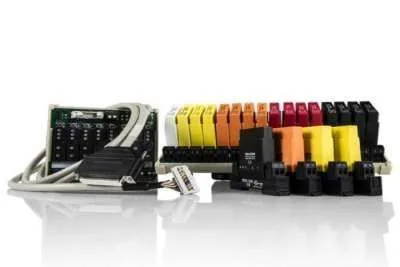
Delcon electronic relays are used in industrial automation systems. They are typical electronic products in that they have a circuit board enclosed in a plastic box. Delcon is a great example of how the effective use of a powerful ERP system in a small company can keep productivity and profitability high.
Using subassemblies to streamline batch manufacturing
There are about 90 different products, and the sales follow roughly the typical 80/20 rule for sales volume.
So the manufacturing is always in two main parts: the circuit-board manufacture and the final assembly and testing. The products are standard design and made to stock with a certain batch size, typically 500, but depending on the exact product.
Before ERP: inefficient business processes
Before implementing Manu Online ERP, they were often making the wrong items at the wrong time.
Many times products were being delivered late, or at least the customer would have liked to receive them quicker, even if deliveries were being made as promised. A spot check on the shop floor revealed an interesting fact: someone was assembling product that was not on the backlog report. However, there were different products that customers were waiting for that were not in stock or being manufactured. People were simply making the wrong stuff.
The simplified reason for this was that a short time before there had been a quiet period, and the production planner had opened a work order for a standard batch of 500 of a common product. This batch was now being taken to completion, which took about five days.
The obvious solution would have been to move to "leaner" manufacturing techniques, perhaps reducing batch size. However, we started to consider the concept of making to stock vs. making to order, and whether there was something we could do to exploit commonality in the product structure to shorten lead times.
Are we making to stock or making to order?
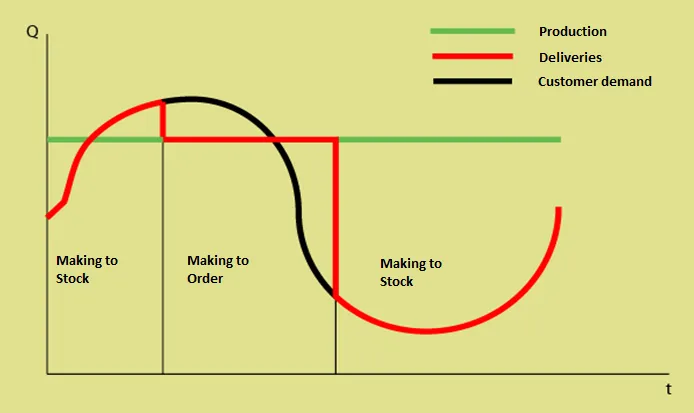
After some reflection, we came to the conclusion that the answer is "both". It depends on the product and the situation with the order book. It changes with time and it cannot be set as a firm manufacturing strategy. In short: when it is busy, we are making to order; when it is quiet, we are making to stock.
Make it complicated to make it simple
The solution was to change the product structure or work-order process from a single-level structure to a four-level one. This sounds like introducing complexity for the sake of it, but we let the computers handle the complexity. What we were aiming for was to exploit the commonality of the lower parts of the product structure so that, when making to stock, we could leave it later in the production process before being committed to a specific final product. Different configuration relays could share the same SMD components but different manually-soldered components. As some relays were sold with branded packaging and labels, this could also be held off to the latest stage.
| Old product structure | New product structure |
|---|---|
| Circuit board | Part board (the reflow-solder board) |
| Box and packaging | Finished board (board with hand components soldered) |
| Relay (white label) | |
| Relay (OEM or branded label) |
How the ERP system helped
Manu Online has a real-time scheduler that also keeps a clear record of what materials are allocated to which orders. This applies at every stage of the manufacturing supply chain: final-goods inventory, work orders (work in progress), subassembly inventory, component inventory and open purchase orders. There is also an immediate reaction to any change in requirements, most typically new orders arriving from customers.
Now make-to-stock work is pushed further down the process chain to circuit-board level, where there is a lot of final-product commonality. This allows work-order sizes to be larger at that earlier stage, but faster and smaller at the later stage. The overall result is shorter lead times for customer orders, even during busy times. When you walk into production with a copy of the order book now, you see people making stuff that is actually needed.
The end result
Delcon runs a lean organisation so that profitability can be maintained even with a turnover of around $1 million. In practice there is no administrative staff: engineers and the owner-manager use the tools of Manu Online Enterprise Edition to manage the business processes with little effort. Manu Online plans the work and purchasing based on preset default rules.